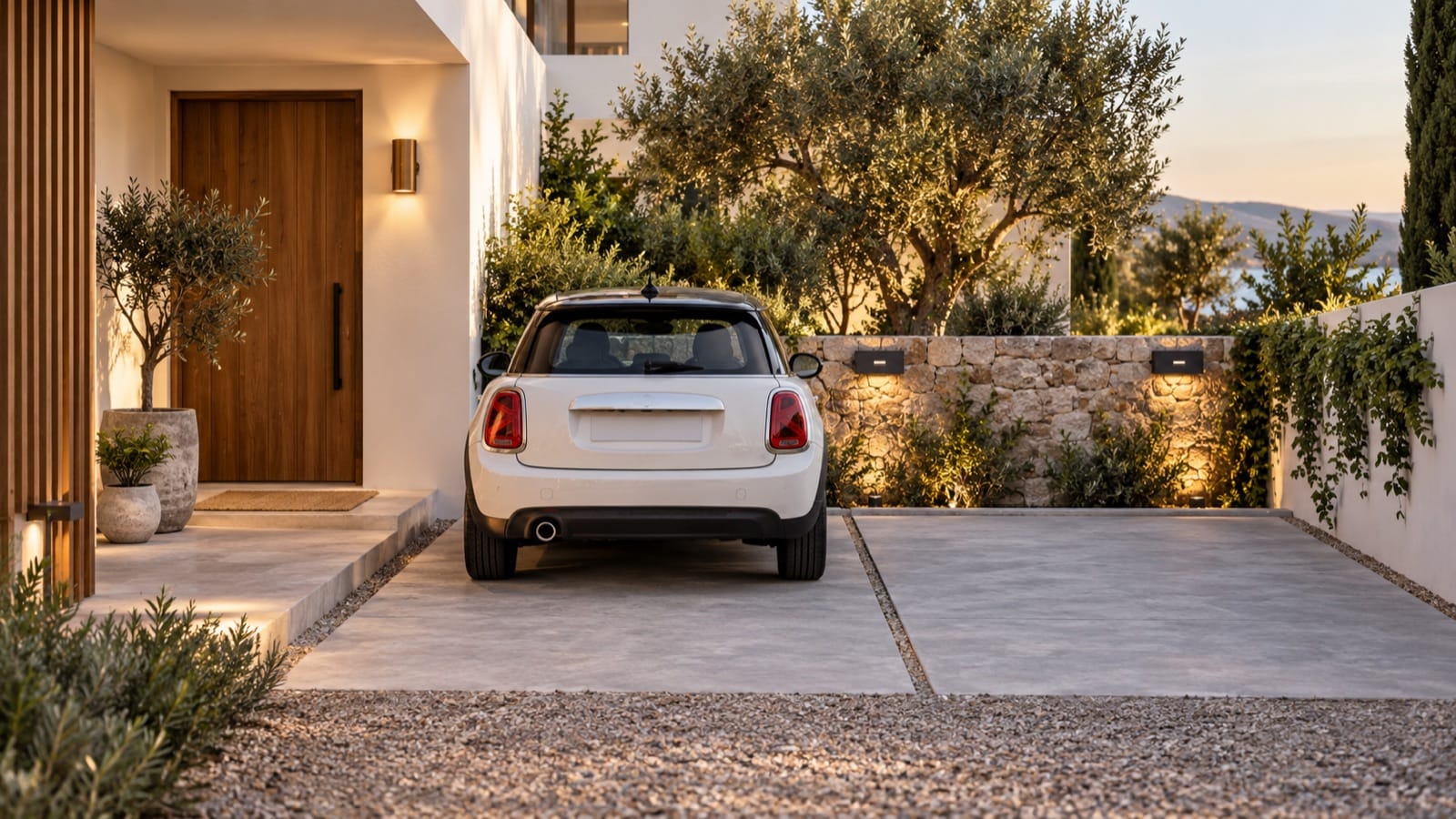
Good Airbnb parking instructions answer four questions: where to drive, which space to use, what restrictions apply, and how to reach the guest entrance afterward. “Free parking available” may describe an amenity, but it does not guide a tired driver into the right bay.
Write the parking section as a short route, with a photograph of the actual space and verified instructions. Keep it separate from the door-lock steps so guests can find each part without reading the whole welcome book.
Use this parking-instructions template
Parking at [property]
Parking location: [exact address or position].
Your space: [bay number or clear identifying feature].
Access: [gate procedure; send sensitive codes privately].
Vehicle limits: [verified height, width, or other restriction, if any].
Permit or registration: [what is required and where to obtain it].
From the space to the entrance: [short walking route].
If the space is unavailable: [verified alternative or host contact].
Remove irrelevant fields. If parking is on the street rather than reserved, state that clearly. Do not suggest that a guest owns a space you cannot guarantee.
Describe the approach from the driver's view
Explain the final turn, driveway entrance, or garage ramp before naming the space. Use stable visible features, such as a numbered entrance. A landmark that only makes sense to neighbours is not enough.
If a map pin leads to the pedestrian gate, include the vehicle entrance separately. Check that the route you recommend is legal and suitable for the guest's vehicle. Do not route drivers through restricted streets simply because a navigation app suggests them.
Photograph the bay and walking route
A useful photograph shows the entrance or bay in context. Add a clear description rather than expecting a guest to recognise a cropped patch of concrete. Avoid showing other guests, readable private vehicle details, or permanent gate codes.
For arrivals after dark, check whether the number and entrance remain visible. Our late check-in checklist explains how to test the full approach at night.
Verify restrictions instead of guessing
- Check whether the bay is reserved, shared, or first come, first served.
- Verify permit rules and any registration process.
- Measure or confirm garage limits from a reliable building source.
- Check current street signs, time restrictions, and payment requirements.
- Explain any loading space without implying it permits overnight parking.
- State whether charging is available only when you genuinely provide it.
Do not promise that a vehicle will not be ticketed or towed. Share verified instructions and make the guest aware that current signs and restrictions still apply. Update the guide when roadworks or building arrangements change.
Give guests a real fallback
Decide what happens if someone else occupies a reserved space. Give a contact who can resolve the problem and, where available, a verified temporary option. Asking guests to use any empty neighbouring bay can create another problem.
For a property without guaranteed parking, provide nearby options with links to current operator information. Make the limitation clear before booking and repeat it in the arrival section.
A short pre-arrival parking message
Hi [first name], parking details are in [guide location]. Use [vehicle entrance] and [space description]. [Permit or vehicle information needed, if applicable.] From there, the guest entrance is [brief route]. If anything is unclear, message us before parking.
Combine this with your check-in instructions, while keeping reservation-specific access details private.
Turn arrival details into a clear route. The Check-in Guide brings your verified parking, entry, and home information into one welcome book.