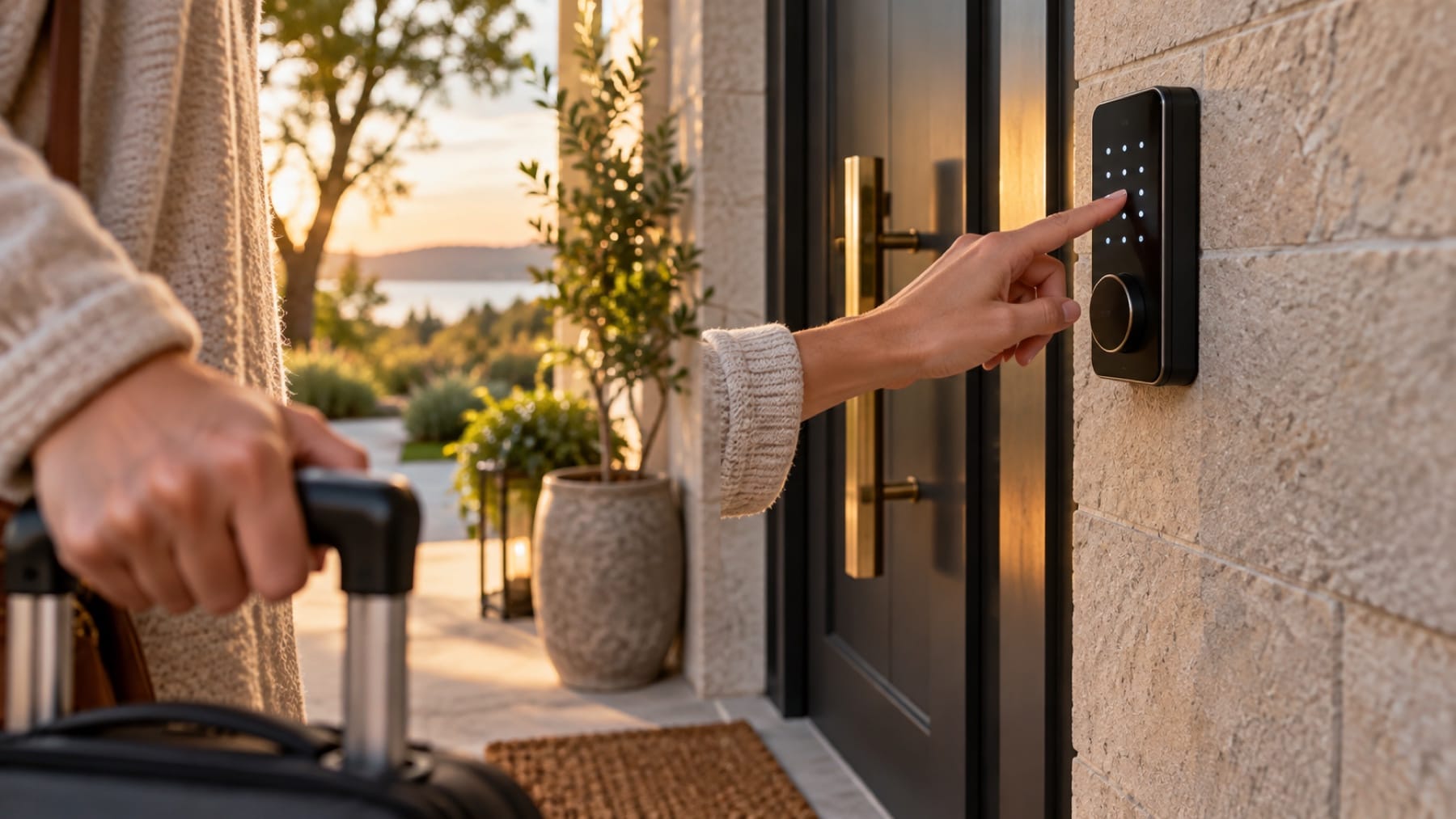
Great Airbnb check-in instructions make sense to someone who is tired, carrying luggage, low on battery, and seeing the street for the first time. They do not merely contain the facts; they put each fact in the order a guest needs it.
Airbnb says detailed check-in instructions become visible to most guests 48 hours before arrival. That built-in guide is important, but a short message and a clear welcome book give guests a second route when they cannot find the right screen.
A foolproof check-in instructions template
Welcome to [property name]. Check-in is from [time].
Address: [full address, unit, postcode]
Map note: [landmark or correction if GPS is misleading]
Parking: [exact space, permit, gate, or street restriction]
Getting inside[Find the correct entrance using a visible landmark.][Open gate/building door; include buzzer or code delivery method.][Locate lockbox/keypad/key handoff.][Operate the lock—include any non-obvious turn, pull, or pause.]
Your access code: [code or “sent separately at time”]
If anything does not work: Call or message [name] at [number].
Once inside, the Wi-Fi and home guide are [location/link]. Safe travels—we're looking forward to hosting you.
Write instructions in the guest's walking order
The useful order is usually:
- Confirm the permitted arrival time.
- Reach the right building or gate.
- Park or unload legally.
- Identify the correct entrance.
- Pass through any shared access point.
- Open the property's door.
- Know what to do if a step fails.
Do not start with the Wi-Fi password or checkout time. Those matter later. Arrival instructions should solve arrival first.
Use landmarks a stranger can recognise
“Turn left after the old shop” only works for locals. Use stable, visible references: the blue pharmacy sign, the second stone gate after the bridge, or the entrance opposite number 42. If several doors look alike, state the colour, floor, and unit number.
Airbnb's hosting guidance recommends adding photos or video to clarify the steps. A useful photo shows one decision: the correct driveway, gate latch, lockbox, or keypad. Avoid wide images with no marker and screenshots that expose permanent access codes.
Explain the lock's one strange thing
Most lockouts happen because the mechanism has a quirk the host no longer notices:
- Pull the door toward you while entering the code.
- Tap the logo first to wake the keypad.
- Turn the lockbox dial clockwise after the last number.
- Push the key in fully before turning left.
- Wait for the green light before moving the handle.
Name that exact action. “Use the keypad as normal” is not an instruction.
Protect access information
Use a unique, time-limited code when your lock supports it. Avoid publishing codes in public listing text, photos, or a welcome book anyone can access. Send sensitive access details through the booking platform or another method that complies with its policies.
If you send a separate guide, keep the directions and visual steps there, but deliver the reservation-specific code securely. Vrbo, for example, distinguishes general welcome-guide access information from reservation-specific access instructions.
Plan for failure before it happens
Every arrival flow needs a fallback:
- A phone number that is answered during check-in hours.
- A co-host, building contact, or nearby backup.
- A charged smart-lock battery and a documented replacement routine.
- A secure spare-key plan that does not expose the property.
- Instructions for late arrival, poor mobile signal, and power failure where relevant.
Test the instructions like a guest
Send the draft to someone who has never visited. Ask them to enter without hints while you watch silently. Any moment where they hesitate is a missing instruction. Repeat the test after changing a lock, repainting an entrance, moving a key box, or when construction changes the route.
A short pre-arrival message
Hi [first name]—your stay at [property] starts tomorrow. Check-in is from [time]. The full arrival guide is here: [link/location]. The entrance is [one-line landmark], and your access code will appear in [secure location] at [time]. If travel plans change, message me here. Have a smooth journey.
Keep the full guide in your Airbnb arrival information and welcome book. The message is a signpost, not a replacement for a tested process.
Sources: Airbnb's instructions help page, Airbnb's check-in guidance, and Vrbo's welcome-guide guidance.
Make the rest of the stay just as clear. The Check-in Guide turns your listing into a polished guest guide with arrival details, Wi-Fi, home instructions, rules, and local recommendations.