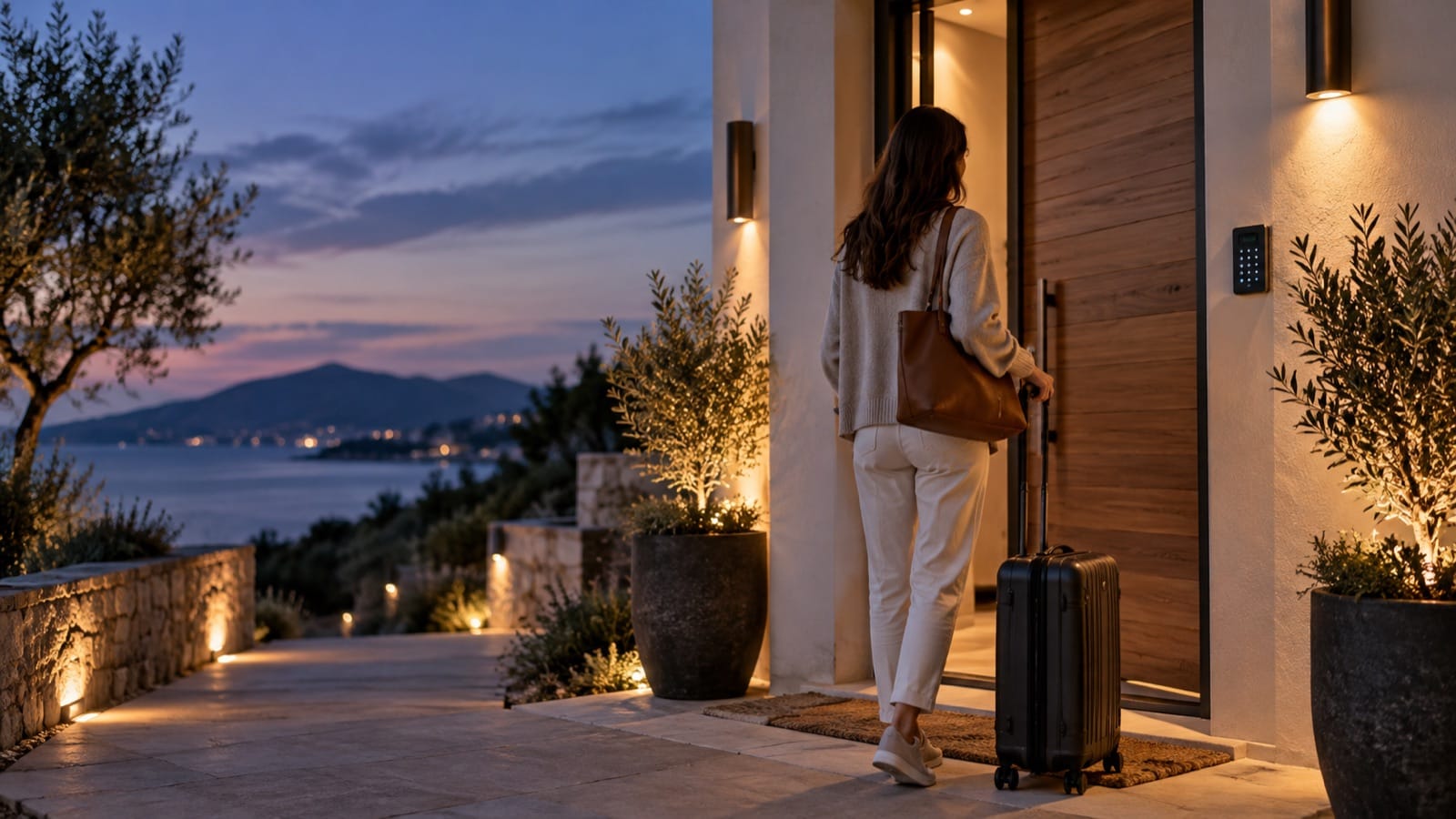
Airbnb late check-in works when guests can find the property, enter it, and reach a real person if access fails. The instructions need to make sense after dark, when a landmark may be invisible and the guest may have little phone battery left.
This guide focuses on preparing for a late arrival. For the complete daytime arrival sequence, use our check-in instructions template. A late-arrival plan adds the lighting, access timing, quiet-entry details, and backup that a general guide may miss.
Decide what late arrival you can support
Set a realistic arrival window based on the property, building arrangements, and available support. If someone must meet the guest, confirm how a travel delay will be handled. If entry is self-service, check that every gate and shared entrance can also be opened during that window.
Airbnb's self check-in guidance describes smart locks, keypads, and lockboxes, and recommends a unique access code for each booking. Choose a method that fits your actual property and test it before offering late arrival.
Test the route after dark
- Is the address or unit number visible from the approach?
- Can a guest identify the correct entrance without entering a neighbour's property?
- Is the path sufficiently lit, including any steps?
- Is the parking arrangement available at the expected arrival time?
- Can the guest see and operate the keypad or lockbox?
- Do motion lights stay on long enough to finish the entry steps?
Take arrival photos at night where useful. A bright daytime photo may hide the fact that a sign cannot be seen after sunset. Describe a stable feature, such as the numbered gate, rather than a business that may be closed and unlit.
A late check-in message template
Hi [first name], we have noted your expected arrival at [time]. Your approved check-in window is [window]. Please tell us here if your travel plans change.
Use [verified entrance or landmark]. Parking is [specific location], and the path light [how it works]. Your reservation-specific access details will be available in [secure location] at [time]. Please save the arrival steps before travelling if mobile reception is limited.
Once inside, please [simple quiet-entry request consistent with house rules]. The Wi-Fi details and home guide are [location]. If you cannot get in, call [person/number]; backup contact is [person/number]. We look forward to welcoming you.
Keep access codes reservation-specific
Deliver sensitive details through an appropriate private channel. Keep permanent codes out of public photos and sample books. Confirm the code becomes active early enough for the agreed arrival and remains valid for the booked stay.
Check the lock battery and have a secure backup process. A fallback is only useful if the person responsible can actually respond during the promised arrival window. Do not list a cleaner's number without arranging that role with them.
Offer information guests can save
Before travel, point guests to the arrival steps and suggest saving them for offline use. Include the full address, entrance photo, contact number, and agreed access-delivery method. A saved guide is especially helpful when the property's mobile signal is weak.
A welcome book can carry stable directions and home information. Send the individual reservation's access code separately. Use your guest messaging sequence to make the location of both clear.
Does self check-in mean 24-hour check-in?
No. State the arrival hours you actually support. A keypad does not override building access restrictions, agreed check-in times, or your ability to resolve a lockout. Confirm late arrival rather than leaving guests to infer it from the amenity.
Help guests arrive with confidence. The Check-in Guide combines your directions, home essentials, and contact information in a guest-ready welcome book.