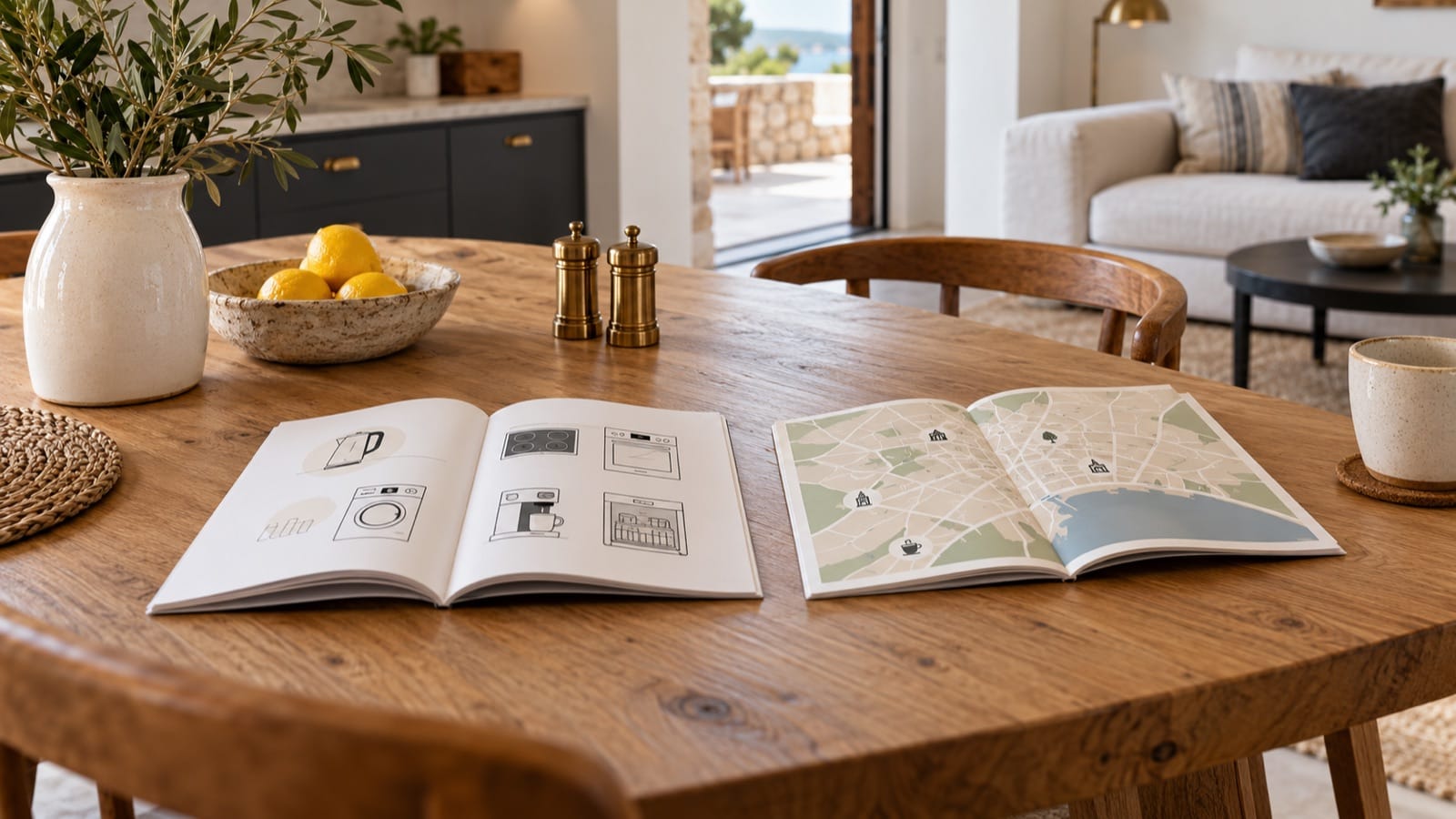
An Airbnb house manual explains how the home works. A local guidebook helps guests decide what to do nearby. A welcome book can bring both together, alongside arrival, contact, and checkout information.
The names often overlap in everyday hosting, but the distinction helps you organise the answers. A guest trying to operate the heating should not have to scroll through restaurant recommendations. Someone choosing dinner does not need to read the washing-machine instructions first.
House manual, local guidebook, and welcome book compared
| Resource | Main question | Typical contents |
|---|---|---|
| House manual | How do I use this home? | Wi-Fi, appliances, supplies, heating, waste |
| Local guidebook | Where should we go? | Food, groceries, transport, activities |
| Welcome book | What do we need throughout the stay? | A combined, organised guest resource |
| House rules | What arrangements must we follow? | Disclosed expectations such as quiet hours and smoking |
This table describes the role of each resource, not a requirement to create four separate documents. Use the formats that fit your property while keeping the categories easy to find.
What belongs in the house manual?
Start with information a guest needs inside the property: network details, appliance controls, spare supplies, temperature controls, and where household waste goes. Explain the installed equipment rather than giving generic instructions for a similar model.
Airbnb's house-manual guidance describes day-to-day information and says the built-in manual is available to guests with confirmed reservations. A separately shared PDF or hosted page has its own access arrangements; check those before adding private details.
House-manual example
The coffee capsules are in the drawer below the machine. Fill the water tank using [verified arrangement], insert a compatible capsule, and press [actual control label]. The full operating card is beside the machine. If it does not respond normally, message us rather than opening any panels.
Replace the placeholders with tested instructions. Our appliance-instructions template gives a consistent structure for those notes.
What belongs in the local guidebook?
Recommend a small number of places for different needs: groceries on arrival, an easy breakfast, a relaxed dinner, a rainy-day activity, and a worthwhile walk. Give a reason to choose each place and a verified route or map link.
Keep ordinary services as visible as sightseeing. A guest staying several weeks may value a reliable supermarket more than a distant attraction. Use our local-recommendation template to make each suggestion specific without creating a directory you cannot maintain.
Where should arrival and checkout go?
Give each its own labelled section. Arrival information is needed before the guest reaches the property, so send it through an appropriate guest channel in advance. Put the normal checkout time and short departure steps near the end, with a clear link or contents entry.
Keep reservation-specific access codes out of a reusable public sample. A guide can explain which door to use and how the lock operates while the individual booking's code is delivered privately.
A simple structure for one combined book
- Arrival and the essential contact.
- Wi-Fi and immediate basics.
- How the home works.
- House arrangements and relevant rules.
- Local food, essentials, transport, and activities.
- Checkout and what to do if something goes wrong.
Use descriptive section names. “How the home works” tells a guest more than “Useful information.” If you maintain a printed version too, keep its facts aligned with the digital guide.
Do you need a separate local guide?
Only if it improves access or maintenance. A large destination list might deserve a separate link; a short shortlist can sit comfortably inside the welcome book. The goal is a clear route to an answer, not more documents.
Bring the useful parts together. The Check-in Guide builds a downloadable welcome book from your listing and verified property details, with a free preview before purchase.